We are taking a different route to Spain this time; we don’t have long so have opted for just two nights between Caen and Marbella, trashing (this time) our usual view that “the journey is the holiday”.
And yet, and yet – three castles in two countries in just over 24 hours, the time to enjoy the play of light on them and to wonder about their history, enough time to wander and wonder through two different places…. Guess what, the journey is still the holiday, there is just a heck of a lot more driving.
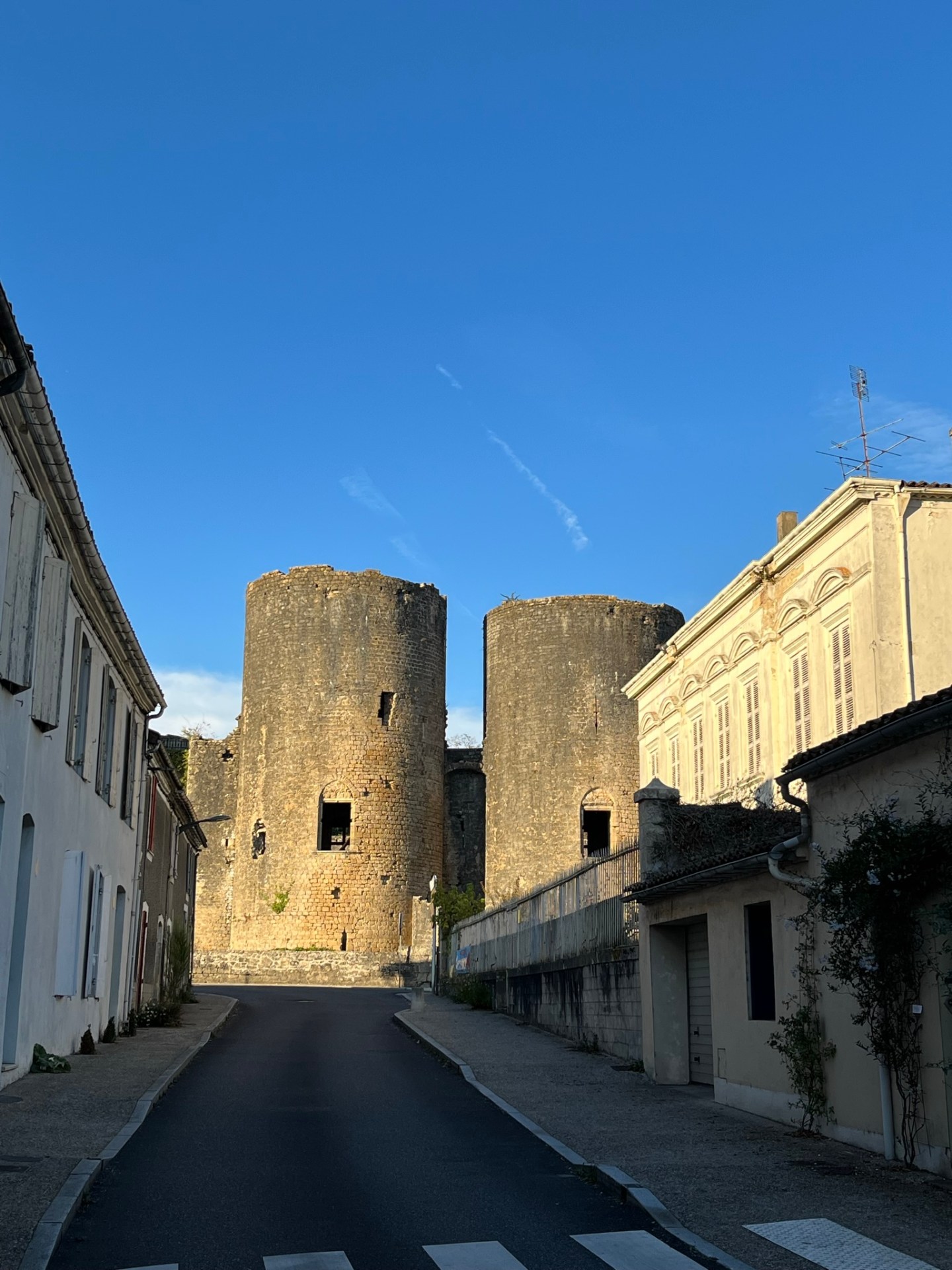
So we made it down to little Villandraut in the Landes, just south of Bordeaux. We’d booked a restaurant with rooms (more of that possibly in a different post – it made us smile but wasn’t one of my great successes…) in a pretty little square lined with plane trees. From the square you could see the sturdy round towers of the castle built by pope Clément V on the site of the castle where he had grown up before going on to become pope and move the papacy to Avignon.
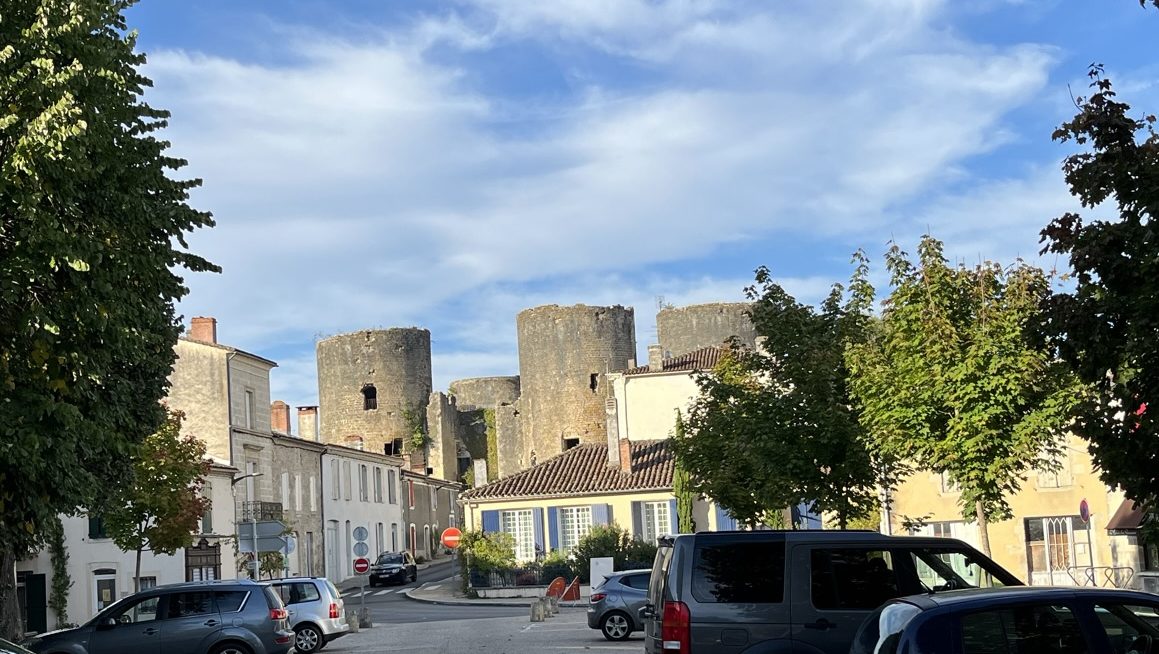
It’s now a ruin, but still looks like the kind of castle a child would draw – towers, crenellations, moat, and all in a beautifully-coloured local stone that glows yellowly in the morning and evening light.
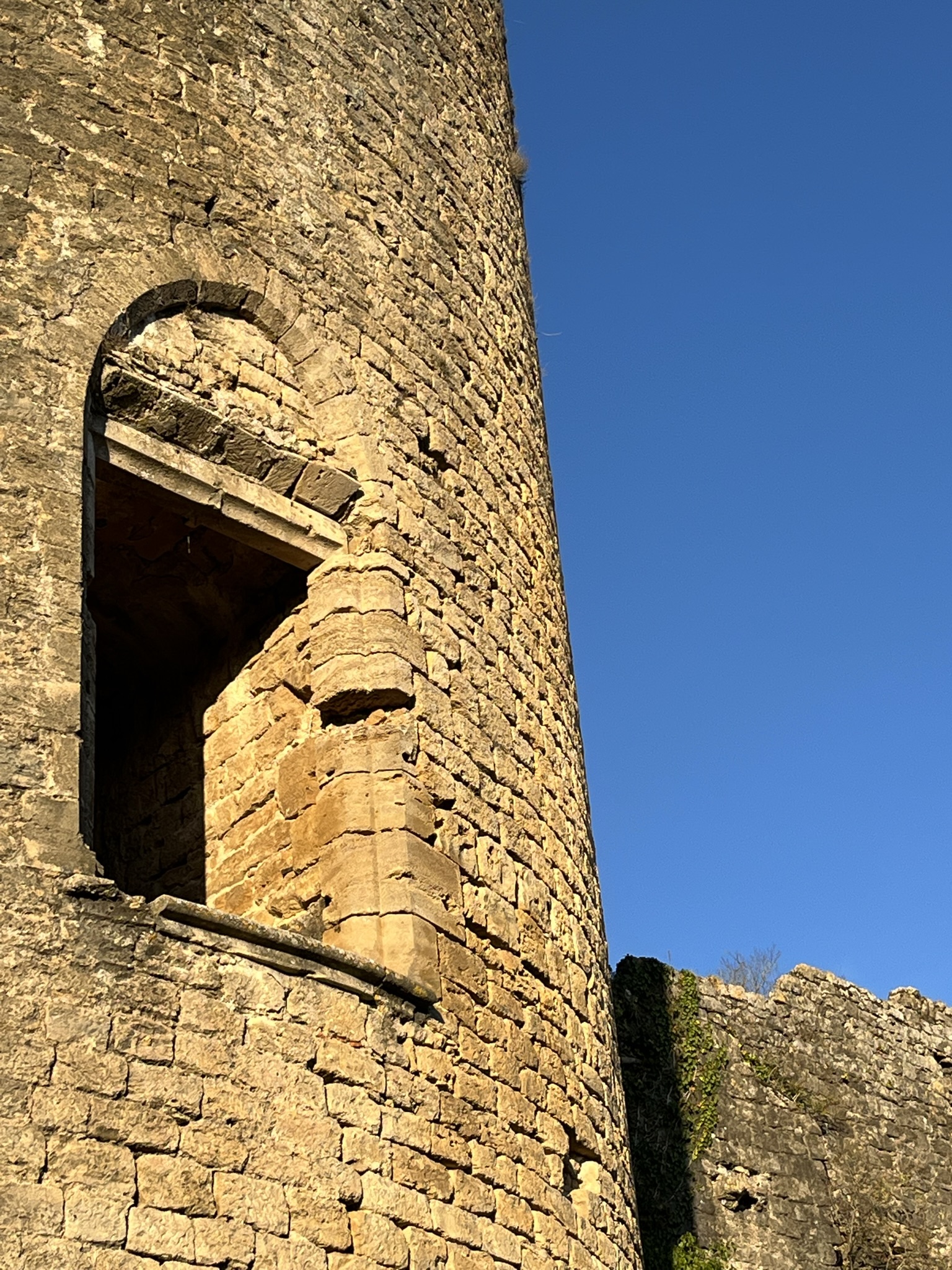
Depending on your mood you could look at this castle with pity – “how the mighty have fallen” – or with admiration – “but I’m still here, still standing, still imposing my presence on this little town”. I am, you won’t be surprised to learn, in the second group. Yes, there are gaping holes where windows have been, and there are arches that go nowhere or have partly collapsed but the building feels solid and determined to stay forever.
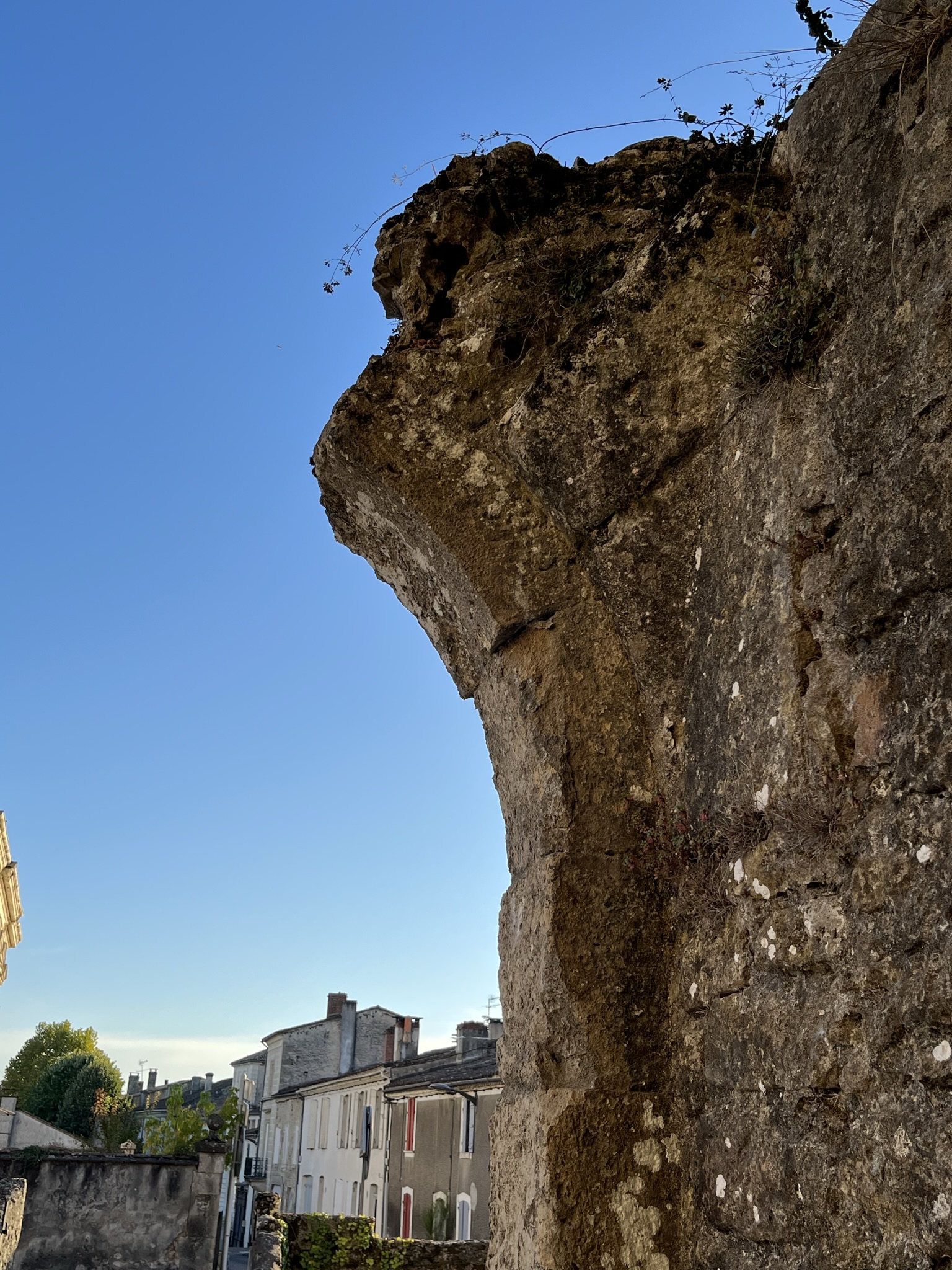
At some point in its more recent past one of the owners must have realised that stones may come tumbling down at any point causing traumatic events such as death to tourists, so they erected a warning sign – I love that the current owner, a businessman from Bordeaux, has kept the sign up despite it being faded and barely clinging to the damaged wall:
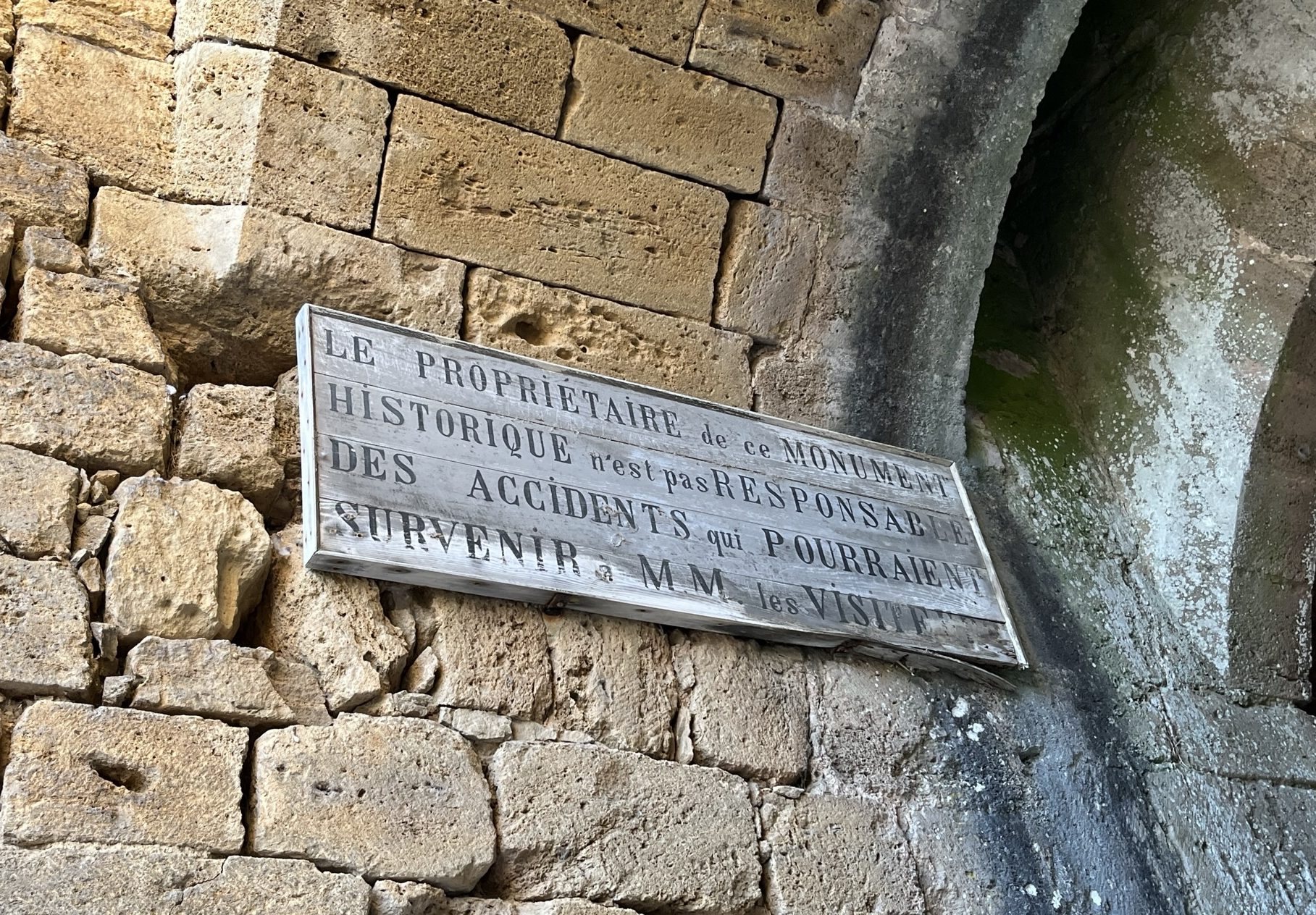
It is possible to make an appointment to go round the castle, but we didn’t have the time and the outside is so beautiful we just enjoyed that. Actually we really did just enjoy that – Villandraut has, apart from where we were staying, 3 cafés (closed), 2 charcuteries (closed), 1 restaurant (closed), 1 beautiful-looking cheese shop (closed) and 2 boulangeries/patisseries (miraculously open). So we bought bread for the picnic but weren’t able to sample any other delights offered by the town. We must have been there on the wrong day.
So we left Villandraut and headed on a minor detour to seek out some Graves wine from a producer at Château Budos; “château” doesn’t always mean “castle”, particularly where wine is involved, so when one loomed up behind the vines against what was now a backdrop of mountainous clouds in way more than fifty shades of grey it was impressive:

The similarities of the castle of Budos with the one at Villandraut are not coincidental – it too was built originally by Clément V, then his nephew developed it further. It also belonged to English kings for a while, being in Aquitaine.
We found the wine producer behind the château, tasted and then bought both some red and some white Graves – it was a delightful reminder of this subtle, multi-layered wine.
We then set off on our long haul across the border to Spain and our eventual destination, the beautiful historic city of Segovia, a little north west of Madrid. The drive took us through the most boring but the quickest crossing from France into Spain, bypassing Hendaye and Irún and taking us through some of the Basque country before heading south towards Madrid and turning off across that brown, desert-like land to be found all around Spain’s capital city.
Because we stayed in the old town we had access to the best of gorgeous Segovia after the day-trippers (in their many thousands) had gone and before they arrived the next morning, and that is how we were able to enjoy the dream-like castle – called the Alcázar here.
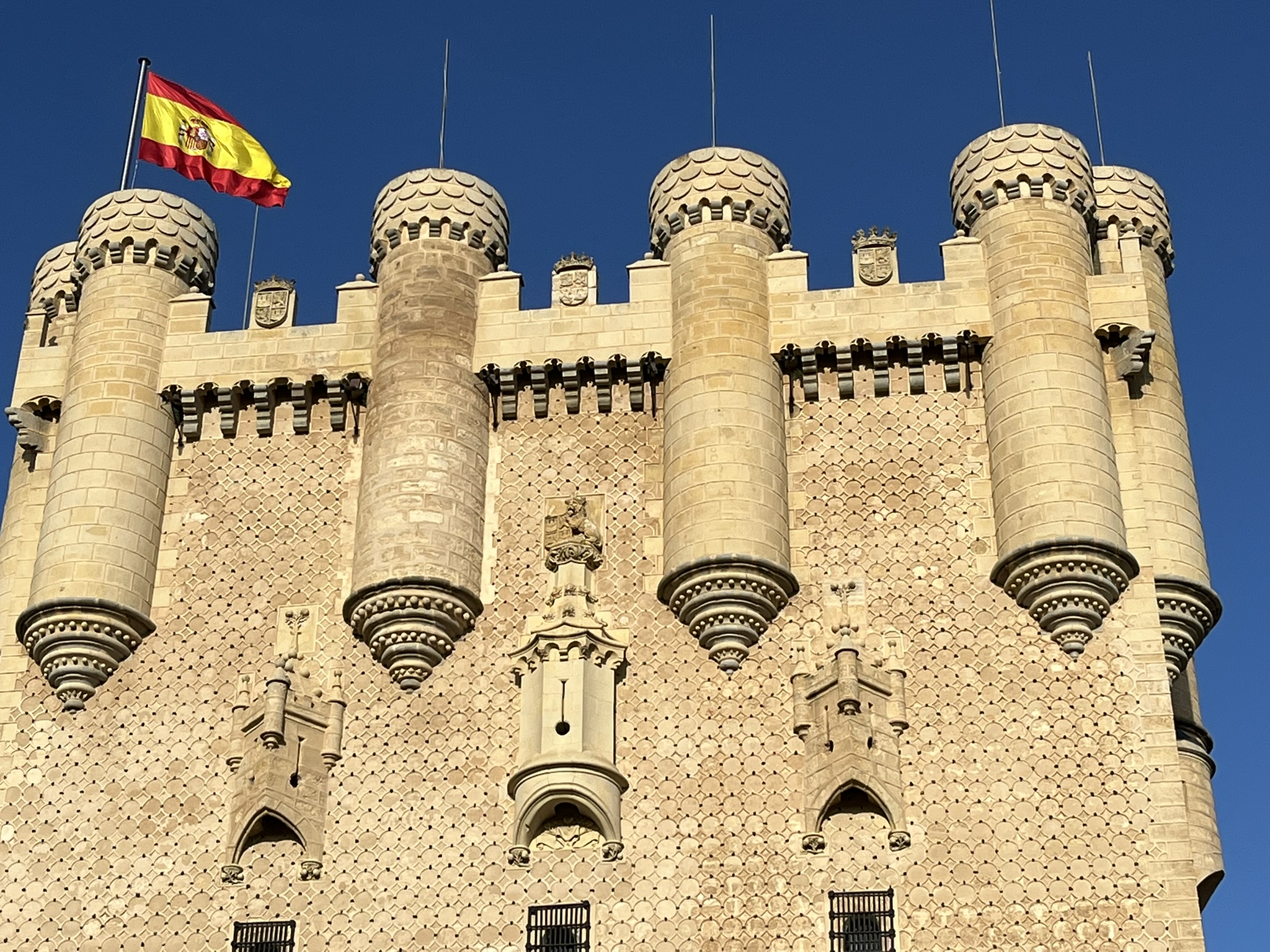
You look at that tower and you understand the defensive purpose of this great building; in fact, you also wonder if it was once a Moorish religious building (it wasn’t) since they were so often re-purposed by the re-conquering Spaniards.
In fact, the Alcázar here was all but destroyed by a huge fire in 1862, despite having survived battles, fires, revolts and other day-to-day events in the life of a castle first built in the 12th century. Apparently, the only thing to survive this fire was a Carduccio painting that someone hurled out of a window as the flames raged; I can find no reference to the art-lover who did this, I do hope they survived. The castle was eventually restored, using old pictures and drawings to reconstruct both the fortress and the more northern European turrets and furbelows that Phillip II (him again) decided would improve the look of the place.
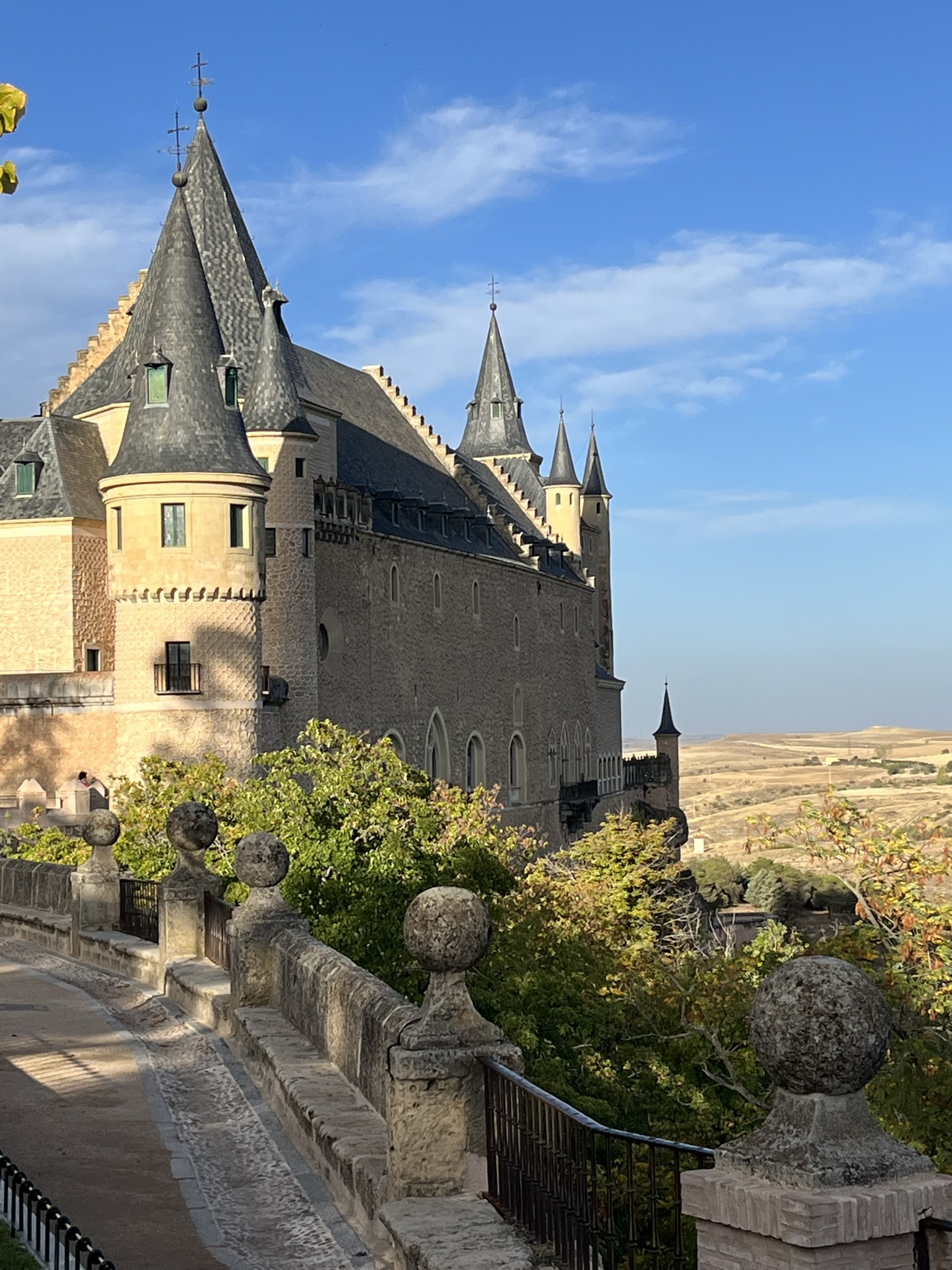
In common with practically every other European castle that has turrets, this Alcázar has been suggested as “one of the inspirations” for Disney’s castle in Cinderella. Carcassonne, Schwangau, Neuschwanstein, Craigievar are names that come up regularly as having inspired Disney; he must have spent a lot of time travelling around Europe doing his research.
Admittedly the juxtaposition of round turrets with grey cones on them with the chunky square “I am fortress” keep (a Yorkie bar made of bricks?) does have an air of fantasy perfectly suited to a Disney film. Perhaps Phillip II should have a ‘set designer’ credit in the films.
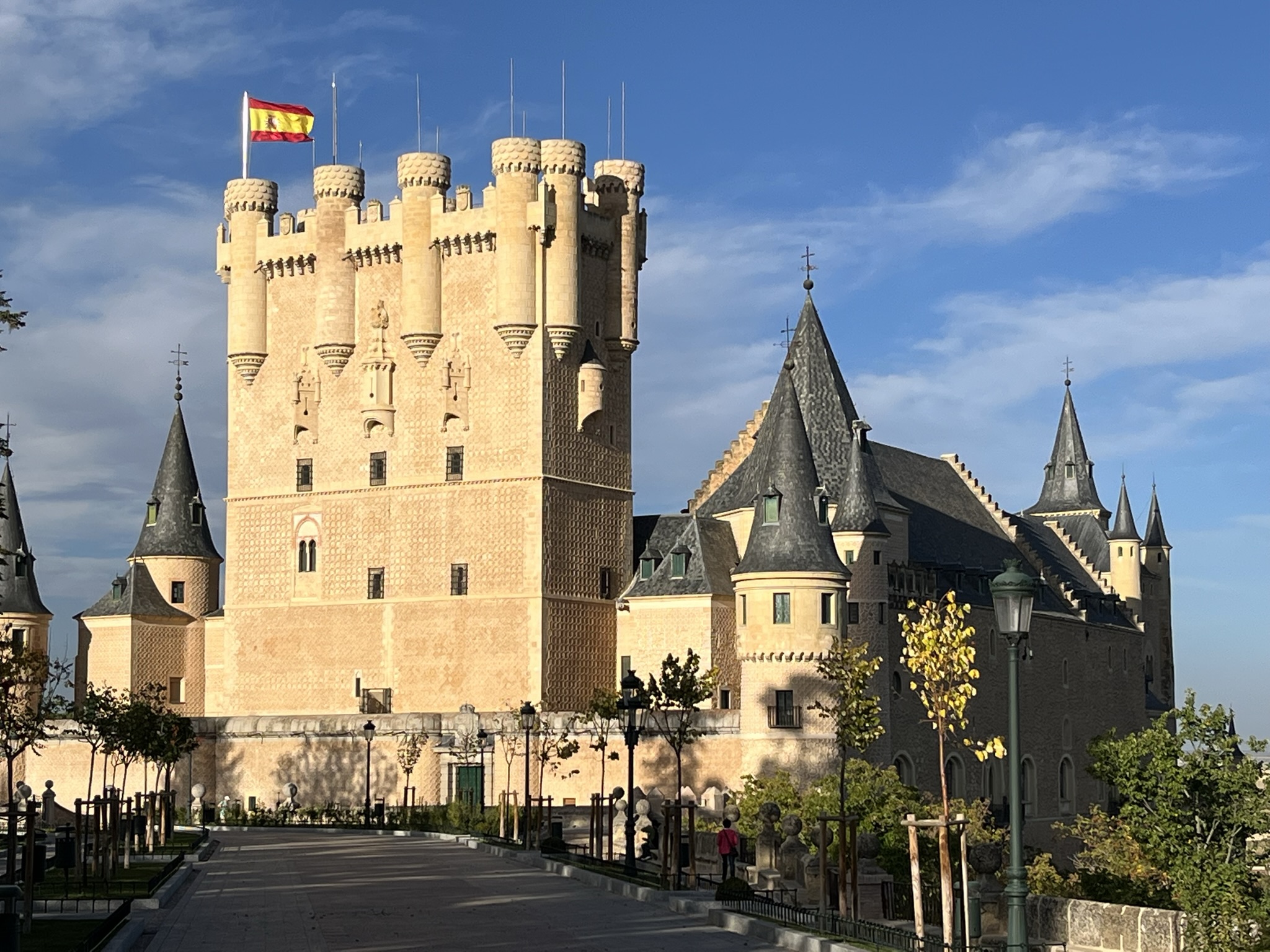
One other thing to mention is the quality of the detail in the restoration. The stone has been worked to within an inch of its life wherever it is visible. I wonder if this may be because mudéjar artisans were used when these towers were originally built; mudéjar was a term used for Moorish craftsmen who were frequently called upon to use their famous skills in the construction of Spanish buildings . Their work stands out for its beauty and detail.

There is so much more to see in Segovia – the cathedral, for example, apparently the last and finest Spanish Gothic cathedral to be built, and of course the famous Roman aqueduct. Of my three castle destinations here, my recommendation is to spend some time in beautiful Segovia because I think you need at least two days here. You will certainly be overwhelmed by the wonderful buildings, and who knows, you may end up writing a multi-million pound animated film?
Discover more from Wined, dined and rested.
Subscribe to get the latest posts sent to your email.
 Wined, dined and rested.
Fran – how fitting that we should see you in los Raices (Istán) as it was reading your blog (via Sally) that alerted me to the fine restaurant it has become! Now I want to pack my bag and head directly to Segovia …. very much enjoying your articles including reading the back list as I am relatively new to your travels.
LikeLike
Hi Annie, thank you! Really glad you’re enjoying the blog, yes you should def head to Segovia – it’s such a buzzy place! Thank you so much for following the blog.
LikeLike
Always a pleasure to read Fran! Do you make notes as you go along? The detail is extraordinary and makes one definitely want to visit these amazing places!
LikeLike
Hi Nene! So glad you liked the article – I don’t exactly make notes, when I visit somewhere, but if a place has left an impression on me I tend to remember things! Yea lease make sure to ‘follow’ the blog so you don’t miss anything and feel free to duress the word!
LikeLike
Ooos – that should be SPREAD the word – absolutely no duress involved!
LikeLike
Could you share details of your accomadation in Segovia? Much appreciated
LikeLike
Hi there, yes of course – we stayed in the Real Segovia by Recordis. Its massive advantage is that you are bang on the centre of the old town so once all the coach parties leave you have the place to yourself. In the evening and at that point it’s a really lovely, non-touristy space. It’s not super luxurious but it’s very Spanish – there is a gorgeous old-fashioned lounge where groups of old folks play Canasta or dominoes of an evening… we put our heads round the door and a sweet little old lady came over and asked if we wanted to join them!!
The hotel is in a pedestrianised area so you have to park down under the Roman bridge and drag your suitcases up the hill, but it’s totally worth it!
LikeLike
Much appreciated
LikeLike