
So there we were in Cádiz for what turned out to be two nights; it was originally going to be three, but there was a certain hotel service breakdown which saw us leaving after two. Suffice it to say that €65 probably isn’t much for a hotel room in the old part of this beautiful city, but even for that one does expect hot water, one’s room to be made up and a room with a window larger than an open Tintin book. The view of the waste pipe and airshaft, and the red mould growing on the shower curtain weren’t complained about, nor was the lack of effective (advertised) wifi or the odd décor consisting of walls with huge stick-on images of a Rita Hayworth lookalike wearing very few clothes, or being told by one employee that the tickets for a discounted car park ticket had “run out” but then being told by the next employee that this was not possible……. but the combination of the previous elements, after about 40 minutes of relatively civilised if repetitive conversation, resulted in us leaving earlier than planned. You win some, you lose some…..
Anyway, that first afternoon in Cádiz we were hungry so we headed to the market to explore, and there we found a venerable old market building surrounded by colonnaded galleries full of food outlets selling all manner of mostly seafood – chocos, atún, chipirones, tortillitas de camarones….
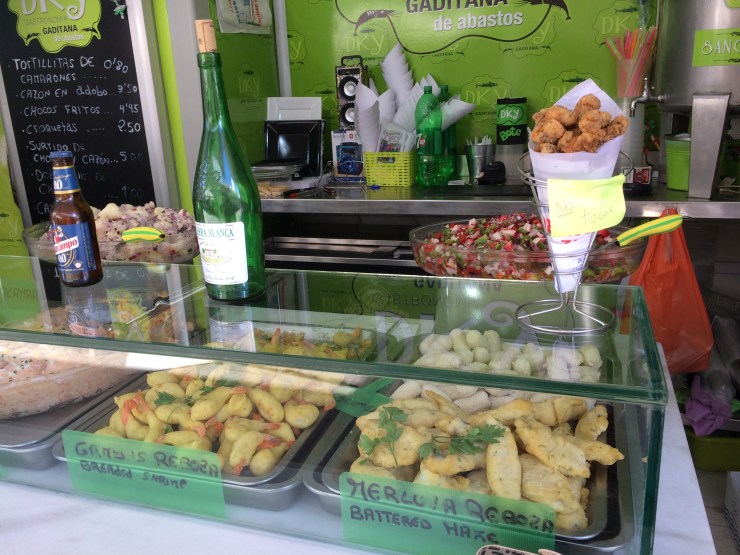
These latter are a particular favourite of mine, partly because of their name. In Mexico we call prawns “camarones”, whereas in most of Spain they are called “gambas”. For some reason, this light mouthful of batter and prawns is called “tortillitas de camarones” in Andalucía, and I consume them with pleasure.

We wandered from stall to stall, enjoying the architecture, the atmosphere and the general Spanish brio, as expressed in noisy chatter.


One of the finest places we discovered, however, was noted as we walked around that afternoon and then visited on both mornings for breakfast. The amazing Restaurante Café Royalty just has to be visited if you ever go to Cádiz. It is an astonishing feat of turn-of-the-century baroque restoration in true Parisian brasserie style – you feel that Renoir might have painted someone in front of those mirrors with their gilded plasterwork, and the painted cherubs disporting themselves around the ceilings have to be seen to be believed.
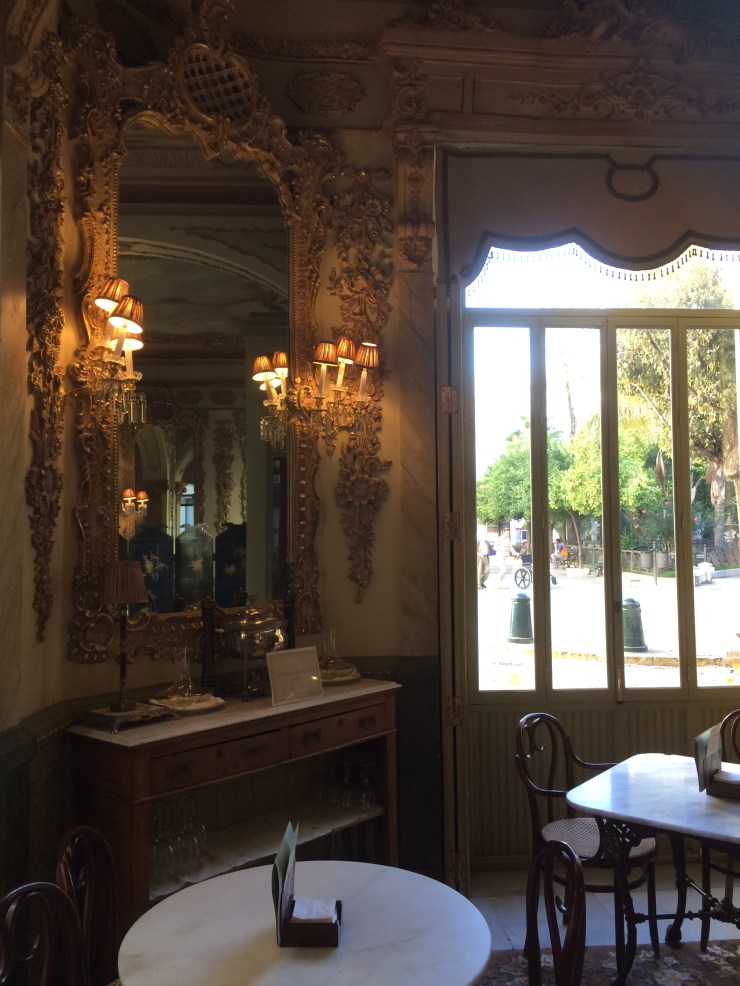
It was lovingly restored between 2008 and 2012, having been a fixture in Gaditano high society between 1912 when it first opened and the early 1930s when it closed. In the interim, it had been used as a warehouse and as pound shop as well as having been left abandoned for long periods, but the family that now own it decided to restore it to its former glory and my goodness what a job they have done.
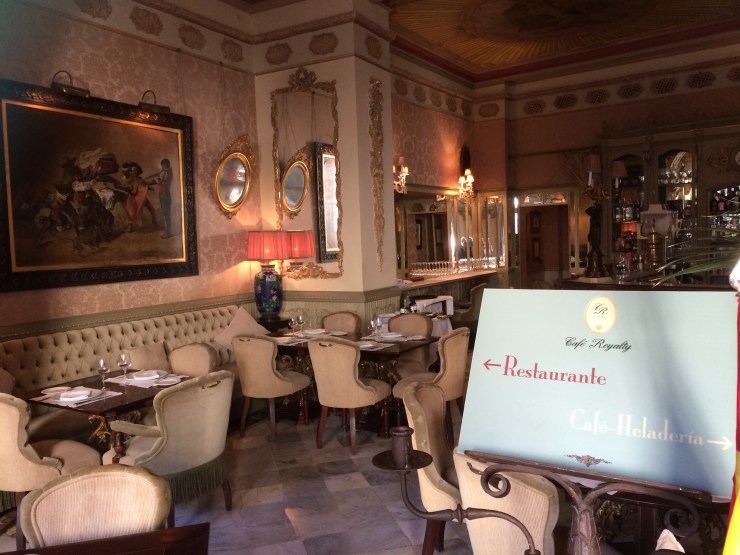
We enjoyed two sumptuous (and not expensive) breakfasts there, but they are also open for lunch and dinner, all with the same service from old-fashioned waiters bringing your food on a wheeled trolley and putting your napkins on the table with tongs.

I think this was probably the venue I most enjoyed in Cádiz, and I will rush back there as soon as I return.
The other experience that we enjoyed in Cádiz was a “sherry tasting” at a bodega across the water in Puerto de Santa María. I put that in brackets because, try as I might, I cannot hear the English word “sherry” without thinking of tutors’ and Directors of Studies’ “sherry parties” at university where we were plied with something sweet in a sherry glass and offered cubes of cheese stuck onto cocktail sticks which were pushed into half an orange. Yes, all the wonderful drinks that I now know and (mostly) love are of course “sherry” in English, but when I order a glass of “fino” or “manzanilla” in a Spanish establishment I experience a thrill of anticipation entirely unrelated to the feeling of dread that fills me if an English person offers me a glass of sherry. This will be because I’m a linguist, I suppose, and the words make such a difference!
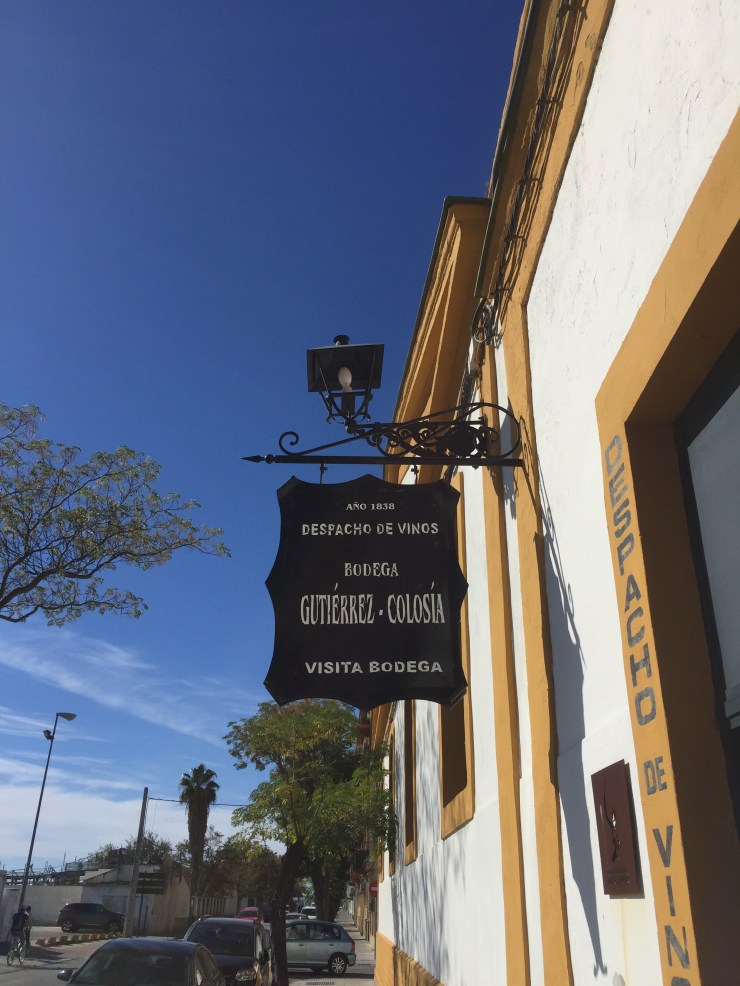
Anyway, we took a ferry across the water, enjoying the warm October sunshine, and took ourselves to the Gutiérrez Colosía bodega for an exceptionally good tour of the property, involving a stroll among the blackened barrels and a really instructive talk by our guide, who turned out to be French.
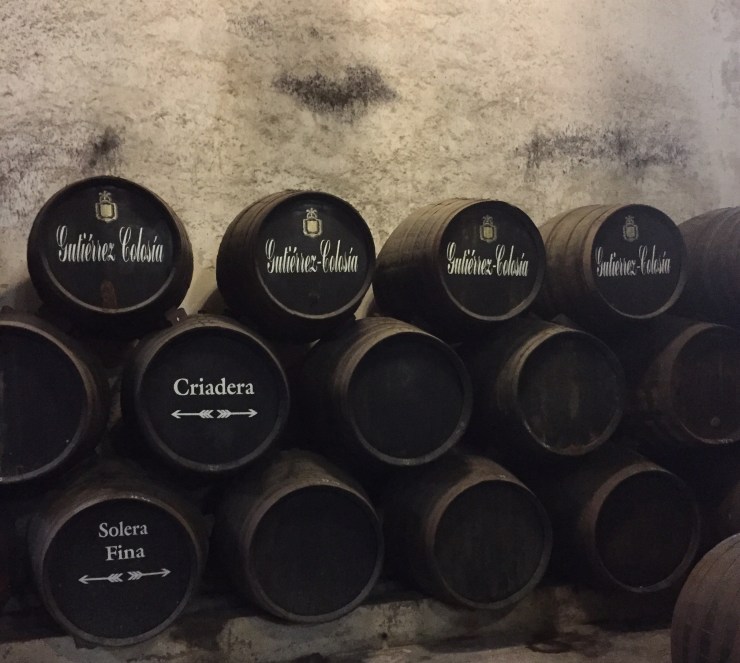
We had some of the mysteries of production explained to us, including how the drink is fortified and how it is moved from the top row of barrels, through the second row and down to the final ground floor row, which is where the name “solera” on the label of a bottle of fino comes from – it refers to the Spanish word “suelo”, meaning ground or floor, which is the level of the barrels from which the final product is drawn.
The tour finished with a tasting of six different sherries, from the driest on the left, “fino”, through to the sweetest on the right, “Pedro Ximénez”. It was absolutely fascinating, and I say that as someone who does not really like anything but “fino”. It turns out that I actually also like “manzanilla”, which is apparently the same as fino but with a saltier flavour because it comes from the coastal Jerez towns, and “moscatel” which is sweet but tastes deliciously of plump raisins.
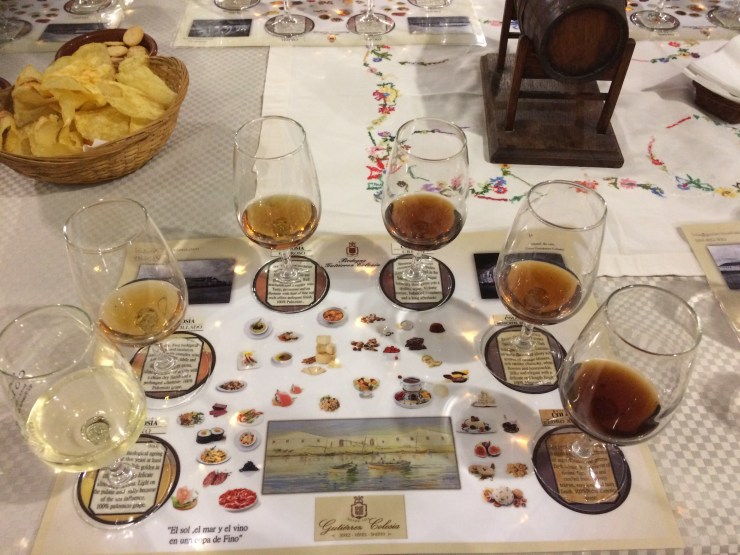
There is a “sherry triangle” formed by Jerez, Puerto de Santa María and Sanlúcar de Barrameda and each town specialises in certain versions of sherry.
Possibly the most interesting piece of information that I took from this tour was that “fino”, being so dry and therefore containing no sugar, makes a very good drink for people on diets. Mmm, I like the sound of “the fino diet”, that has to be one to try.
Discover more from Wined, dined and rested.
Subscribe to get the latest posts sent to your email.
 Wined, dined and rested.
What a great read. Wish I were there!!!
LikeLike
Great tips on Cadiz. Fancy that boat trip!
LikeLike